

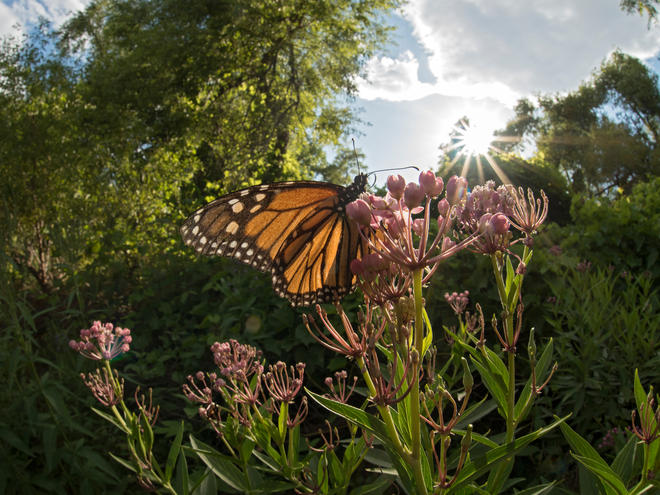
The latest survey of monarch butterfly habitat in Mexico is a testament to the power of conservation. The area of forest occupied by hibernating monarch butterflies in Mexico has increased by 144% in relation to last year’s survey—the biggest in the past 12 years. A new colony of monarchs was also found in the Nevado de Toluca, State of Mexico.
Because we can’t count butterflies individually, we instead measure the area of forest they occupy during hibernation to get a sense of the overall population. This year’s survey, conducted by WWF-Mexico and partners, found monarchs in 14.94 acres of forest, up from 6.12 acres at the same time last winter. Researchers found eight butterfly colonies in the Monarch Butterfly Biosphere Reserve and six colonies outside of it. The largest colony occupied just over six acres of forest.
Monarch butterflies travel close to 2,500 miles from Canada and the United States to spend the winter in Mexico’s forests where a less extreme climate provides them a better chance at survival. Their populations fluctuate, so it’s necessary to continue to address the threats they face. Climate change, forest degradation in places where monarchs hibernate, and the conversion of grassland to farmland along their migratory route all impact the species.
With that in mind, the United States, Canada, and Mexico set out to conserve and protect monarch butterflies by establishing a high-level taskforce for conserving the monarch’s migration in February 2014.
Scientists, governments, and civil society are all playing a part in protecting monarchs. In the US, people responded to a call to plant milkweed, the only plant where monarchs lay their eggs, and from which monarch larvae feed; and in Mexico, WWF and other organizations, are working to establish gardens with flowers to feed them with nectar during their trip.
While this work and the new survey results are promising, we still have more work to do. Monarch populations remain far smaller than they were 20 years ago. You can help. Sign on to save the monarch butterfly.
Published January 29, 2019 at 08:00PM
View on Worldwildlife.org